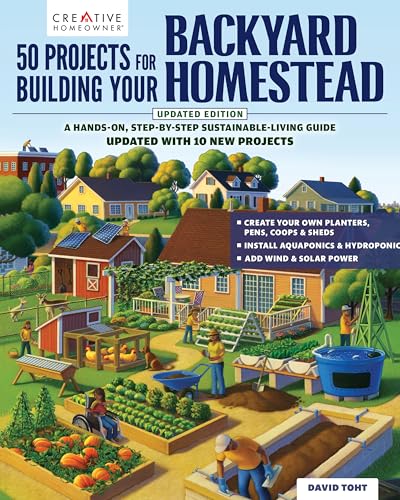
50 Projects for Building Your Backyard Homestead is a bare-bones, no fluff collection of practical tutorials for more self sufficient living collected and curated by David Doht. Originally published in 2011, this updated and reformatted edition was released 25th Feb 2025 by Fox Chapel on their Creative Homeowner imprint. It's 272 pages and is available in paperback and ebook formats. It's worth noting that the ebook format has a handy interactive table of contents as well as interactive links and references throughout.
This is not a book which is heavy on the dreams & planning aspects of living frugally, off grid, or actually evaluating, buying, and keeping livestock. The author does an admirable job of "staying in his lane" and providing concise, clear, accessible, and do-able tutorials for a very wide range of homestead chores: building solid shelters, adapting and installing raised beds, housing chickens (but not sourcing them or keeping them problem free), installing fencing, building beehives (but not sourcing or keeping bees) and a host of other tasks. These are *tutorials* and not theory.
The book has a logical layout with information arranged thematically: garden structures, fences & pens, housing chickens, building sheds, wind & solar power, aquaponics & hydroponics, beehives, and plumbing & wiring. There's also a cross-referenced index as well as an abbreviated resource links list. Tutorials are written with introductions & purposes, bullet lists of tools and supplies needed (measurements mostly in imperial (American) units, but some (especially pipe diameters) also in metric measurement/gauge), and step-by-step instructions. The book is very well photographed and illustrated in color throughout. Action shots are take unimpeded by tools, clothing, or hands, in the way of the action.
This is a good beginner to intermediate guide for people who are interested in decreasing their dependence on local supply chains and find themselves floundering a bit to know where to start in their own backyards. Recommended for public or school library acquisition, gardening and maker's groups, community gardens, and related groups as well as would-be suburban homesteaders. There is unlikely to be much in-depth info which would be of use to truck-farmers or actual homesteaders.
Four and a half stars.
Disclosure: I received an ARC at no cost from the author/publisher for review purposes.

No comments:
Post a Comment